
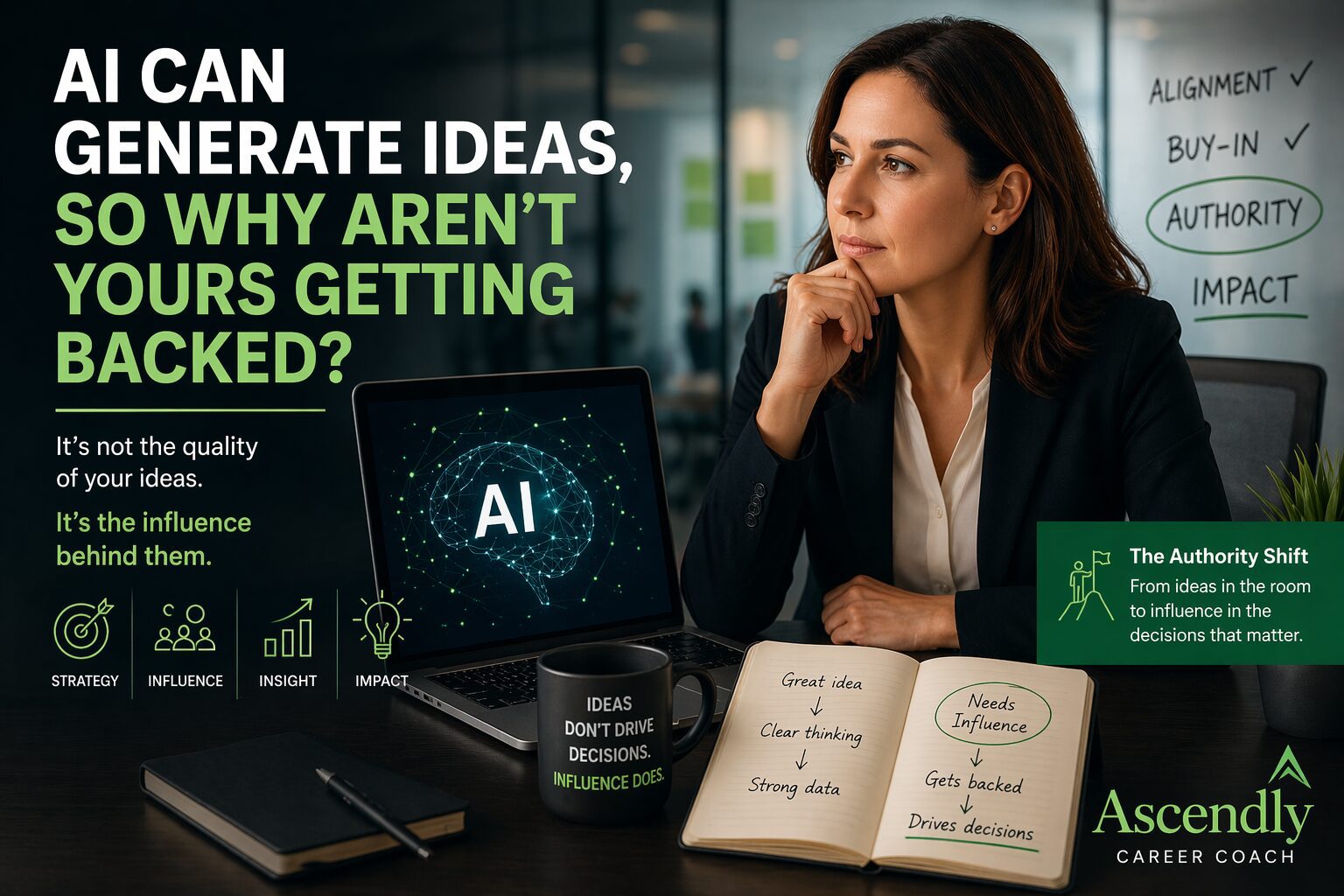
AI Can Generate Ideas, So Why Aren’t Yours Getting Backed?
There’s no shortage of ideas right now.
In fact, that’s part of the problem.
With AI tools now embedded into how we work, thinking has become faster, broader, and more accessible. You can generate strategies, analyse data, draft proposals, and sense-check decisions in minutes.
So logically, you’d expect better ideas to win more often.
But that’s not what’s happening.
Instead, many senior leaders are finding themselves in a familiar position:
You bring forward a well-thought-out idea. It’s supported, structured, aligned to the business and still, it doesn’t quite land.
It gets acknowledged.
It gets discussed.
But it doesn’t get backed.
Meanwhile, another idea sometimes less developed, sometimes just better timing gains traction and moves forward.
And it leaves you wondering:
If the quality of thinking isn’t the issue… what is?
The Shift AI Has Created
AI hasn’t just changed how we generate ideas.
It’s changed the value of ideas themselves.
When ideas were harder to produce, having a good one gave you an advantage.
Now that ideas are abundant, the advantage has shifted.
It’s no longer:
–Who has the best idea?
It’s:
– Whose idea gets backed?
And that comes down to something AI can’t do for you:
It’s Influence.
The Decision Impact
At more senior levels, your value isn’t measured by how many ideas you contribute.
It’s measured by how many of those ideas:
- gain traction
- shape direction
- translate into decisions
This is where many high-performing leaders feel the gap.
Because they’ve adapted to new tools.
They’re producing strong thinking.
They’re keeping up with change.
But their level of influence hasn’t evolved at the same pace.
And that’s where friction shows up.
Why Good Ideas Still Don’t Get Backed
From the outside, it can look like politics, bias, or timing.
Sometimes it is.
But more often, it comes down to three underlying factors:
1. The Idea Isn’t the Only Thing Being Evaluated
When you share an idea, people aren’t just assessing the content.
They’re (consciously or not) assessing:
- your credibility in that space
- your track record of influencing outcomes
- how aligned your thinking is with broader priorities
In other words:
- The idea is filtered through your personal brand.
If you’re known as:
- operational
- delivery-focused
- dependable
Then even a strategic idea can be received through that lens.
Not dismissed but not fully backed either.
2. Influence Happens Before the Idea Is Presented
In fast-moving environments, decisions are rarely made in the meeting itself.
They’re shaped beforehand.
Through:
- informal conversations
- stakeholder alignment
- early testing of thinking
If your idea is introduced cold in a group setting, it’s competing for attention.
If it’s been socialised early, it arrives with momentum.
Same idea. Different outcome.
3. Clarity Isn’t the Same as Relevance
AI is excellent at helping you structure clear, logical thinking.
But clarity alone doesn’t create traction.
Leaders back ideas that are clearly connected to:
- business priorities
- risk mitigation
- strategic direction
If that link isn’t explicit, the idea can feel interesting but not essential.
Where Many Leaders Are Getting Stuck
What I’m seeing more with senior leaders is this:
They’ve upgraded how they produce ideas…but not how they position and influence with them.
They’re:
- sharper
- faster
- more informed
But still operating with an outdated assumption:
“If the thinking is strong enough, it will speak for itself.”
It won’t.
Not in this environment.
The Authority Shift: Leading Beyond the Idea
This is where the real shift needs to happen.
Not away from good thinking but beyond it.
I call this The Authority Shift.
It’s the move from:
- contributing ideas
to - driving decisions
And it requires a different way of leading.
What That Looks Like in Practice
Here are a few shifts that become critical in an AI-enabled environment:
1. From Idea Generation → Idea Ownership
It’s not enough to bring an idea forward.
You need to:
- shape how it’s understood
- guide how it’s discussed
- stay connected to how it evolves
Otherwise, it can easily be reinterpreted, diluted or picked up by someone else with stronger positioning.
(We’ve all seen that happen.)
2. From Clarity → Strategic Framing
Before you present an idea, ask:
- Why does this matter now?
- What problem does this solve at a leadership level or team or customer?
- What decision does this enable?
This is what turns a good idea into a compelling one.
3. From Presence → Positioning
Being in the room is no longer enough.
You need to be known for something specific:
- a way of thinking
- a perspective
- a type of contribution
Because when people have a clear mental vision of you, your ideas carry more weight.
Without that, each contribution starts from neutral.
4. From Reacting → Pre-Aligning
If you want your ideas backed, don’t wait for the meeting.
Have the conversations before:
- test your thinking
- understand objections
- build support
So when you enter the room, you’re not introducing an idea, you’re advancing it.
A Subtle but Important Reality
AI will continue to accelerate how quickly ideas are generated.
Which means:
– Ideas alone will become less differentiating over time.
But influence?
That becomes more valuable.
Because someone still needs to:
- decide what matters
- align people around it
- move it forward
That’s leadership.
Lastly,
If your ideas aren’t getting backed right now, it’s easy to question the thinking.
But more often than not, the issue isn’t the idea.
It’s the gap between the idea and the influence behind it.
And that gap is where many capable leaders are currently sitting.
The opportunity isn’t to produce more ideas.
It’s to become more intentional about:
- how your ideas are positioned
- how they’re perceived
- and how you lead them through to decision
Because in this environment, the leaders who stand out won’t be the ones with the most or best ideas.
They’ll be the ones whose ideas actually shape what happens next.
If This Resonates
If you’re finding that your ideas are solid but not gaining the traction they should, it’s worth paying attention to how you’re showing up around them.
This is the work I focus on with leaders through The Authority Shift:
Helping them move from contributing ideas…
to becoming the leader whose ideas get backed, adopted, and drive decisions.
Because that’s the shift that defines real impact now and going forward.
Shirley Sutton
Executive Career Coach | NLP Practitioner
Helping ambitious professionals accelerate with clarity, confidence, and strategic influence.